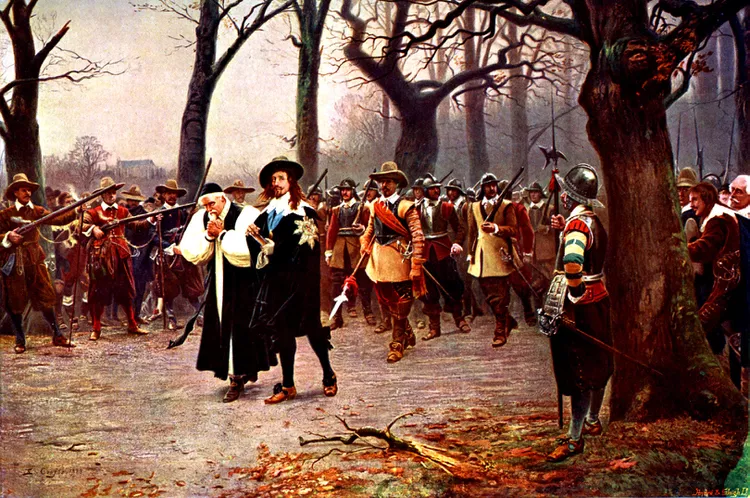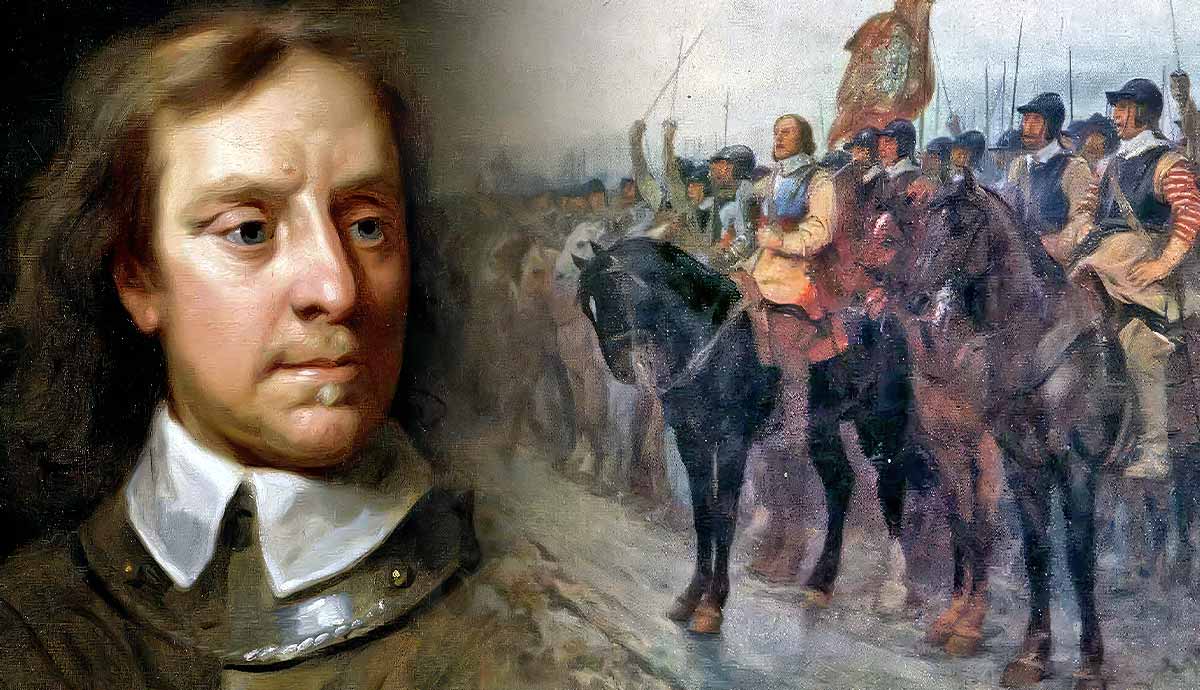
1625 AD. On the death of James I, Charles I became King of the Three Crowns. However, his attempts to establish an unlimited monarchy led to war between him and the English Parliament in 1639. The Parliamentarian forces were led by Oliver Cromwell, a parliamentarian. After a long civil war, Charles I was defeated and executed in 1649. With him, the monarchy known as the ‘Union of the Crowns’ came to an end.
Oliver Cromwell, who brought the English Parliament under his control, established a republic called the ‘Commonwealth of the People’. However, Scotland and Ireland supported the monarchy by accepting Charles I’s son, Charles II, as their king. Subsequently, Cromwell’s forces defeated Charles II and removed the monarchy from those countries as well. The three countries were reunited under Cromwell’s leadership. The Commonwealth of England was born as a new republic.
During this period when the monarchy was completely abolished, the traditional ‘Royal Arms’ shield with lions representing the royal family was completely abandoned. A new republican shield was put forward by combining only the flags of the three countries.
Cromwell, who established the first Commonwealth Republic of Britain, tried to introduce democratic practices several times during his reign. However, he did not get any results. Moreover, the parliaments formed during his time did not function successfully. Since his supporters were unable to establish a well-functioning republic, he was forced to run a dictatorial regime. Cromwell’s government moved with the support of the army. At the same time, he refused to accept the crown when it was offered to him, and ruled Britain from 1653 to 1658 with the title of ‘Lord Protector’.
Although he ruled with the help of the army, during this 5-year period, Cromwell gave Britain a general good taste. He reformed the uneven administrative system and established a uniform administrative system. Many harsh laws were also reformed. He supported education. Cromwell, who was a deep believer in religious tolerance, allowed the Jews who had been expelled from England by King Edward I three centuries earlier to settle in England and practice their religion freely. He also implemented successful foreign policies.
Cromwell never hesitated to accept the crown or establish a permanent dictatorial rule, considering the rare opportunity presented. His rule was mostly neutral and conciliatory. As a result of Cromwell’s contributions in various ways, democracy in England was established and strengthened.
Britain today functions as a successful commonwealth. But it is to Cromwell that the credit for establishing a strong foundation, a model of government, and a hope for the future belongs. To represent him and his reign, a white lion on a black background was featured on the shield of three flags throughout his reign from 1653 to 1658.
The restored monarchy and the Royal Arms
Cromwell’s death opened the door to Charles II, who had fled Britain, to the throne. In 1660, he became king again and restored the monarchy in all three British kingdoms. The Royal Arms, the symbol of the monarchy, were also restored. The lions of England and Scotland became the lions of Great Britain.
At the same time, Oliver Cromwell’s body was exhumed from his grave and hanged on a pole. This action by Charles II, in revenge for Cromwell’s execution of his father, Charles I, was a crushing defeat for the struggle to establish an absolute monarchy. Realizing this, Charles II was forced to accept the right of Parliament to rule without opposition. As a result, a new form of government called “Constitutional Monarchy” was established in England. According to this, the king became strictly subordinate to parliament. In addition, the policy of religious tolerance became one of the main policies of the government.
About the Author